How to Build Strong E-E-A-T Signals for SEO and AI Search
You can build strong E-E-A-T signals by showing real hands-on experience in your content, highlighting the real people behind your business, stating realistic claims with clear prices and refund terms, and earning authentic customer reviews and mentions across the web. When these trust signals align, Google and AI search engines have clear reasons to recommend your business.
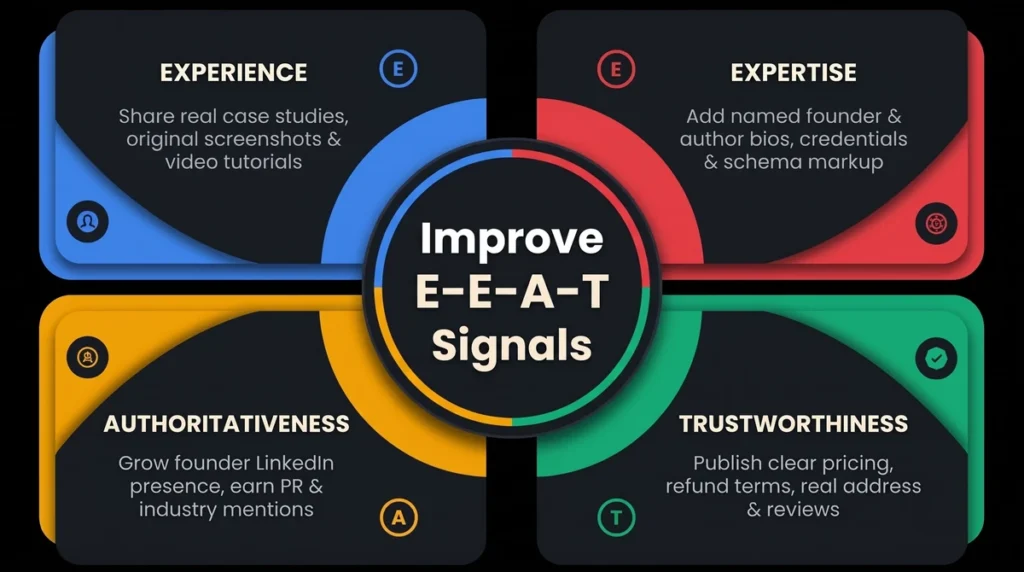
E-E-A-T is not a random ranking score. It is a trust signal that shows how honest, experienced, and reliable your business really is. Once you understand how E-E-A-T works inside Google’s Search Quality Rater Guidelines, the next step is turning those principles into visible proof on your website and across the internet.
To see which signals show up most often on winning websites, our team studied 66 small and mid-sized businesses across 33 head-to-head industry pairs. In each pair, one business performed strongly across both traditional search rankings and AI search engines (ChatGPT, Google AI Overviews, Perplexity, and Gemini), while a similar competitor in the same market got skipped. We excluded tech giants like Microsoft so every lesson below fits a growing business.
How Do the Three Layers of E-E-A-T Work Together
E-E-A-T works as three connected layers where your content proves what you know, your founder and company pages show who stands behind the work, and independent sources confirm your claims are true.
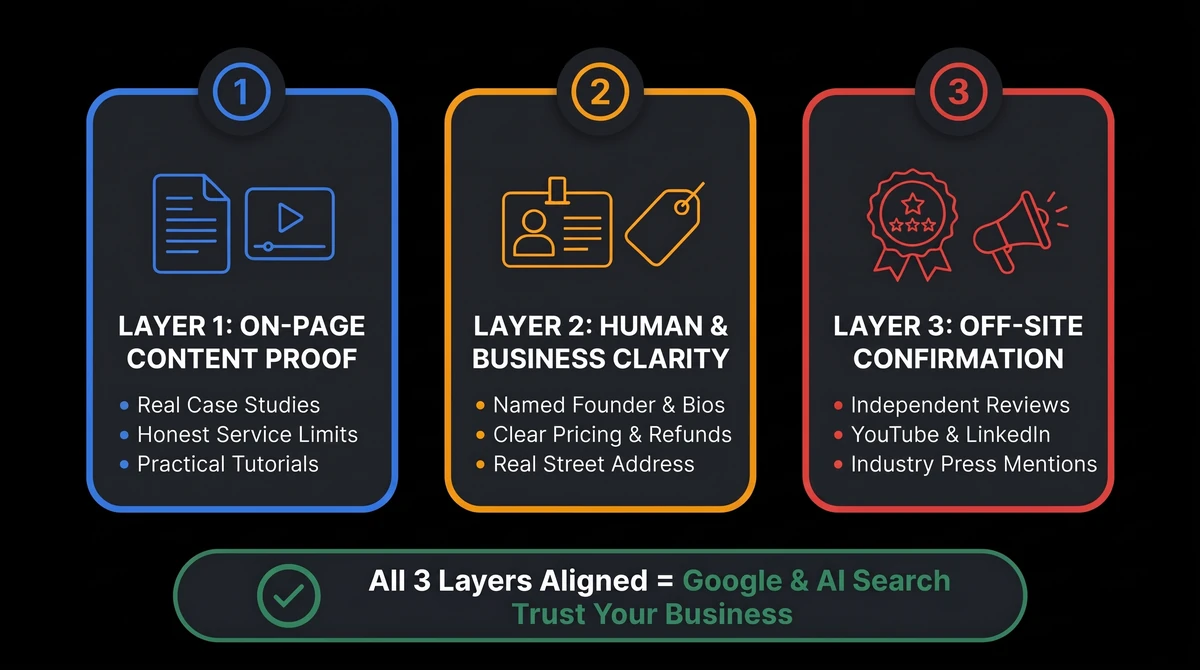
Adding an author box under a blog post does very little if your site hides who owns the company, locks prices behind a form, or makes exaggerated promises. Search engines and AI tools judge your content, your human identity, and your outside reputation together.
- Layer 1 is content proof on the page. Real case studies, honest product limits, and practical workflows that show you have done the work.
- Layer 2 is human and business transparency. Named founders and authors, verifiable credentials, a real street address, clear pricing, and plain-English refund terms.
- Layer 3 is independent off-site confirmation. Authentic customer reviews, educational YouTube videos, active founder networking, and press mentions that match your on-site claims.
Do You Need a High Semrush Authority Score to Get Recommended
No, a larger backlink profile helps, but strong business transparency and trust signals can help a lower-authority domain beat bigger competitors.
While backlinks remain a core part of how SEO works, live Semrush data across all 33 pairs in our study showed that the recommended business had an equal or lower Semrush Authority Score than the skipped competitor in 12 of the 33 pairs. In 7 pairs, the winner also had lower organic traffic, and raw referring domain counts did not meaningfully separate the two groups. We saw the same pattern when studying how to get cited in Google AI Overviews, where clear facts and trust signals beat higher-ranking pages that lacked proof.
Organic reach still helped overall, as the recommended business held higher organic traffic in 25 of the 33 pairs. Treat links and traffic as useful long-term assets, and treat transparent business facts, real proof, and visible human leadership as the advantages you can build fastest.
How Can You Build E-E-A-T in Your Content Writing
You can build strong E-E-A-T in your content by sharing real project outcomes, stating honest boundaries instead of empty hype, recording practical video tutorials, and linking claims to original sources.
How Do You Show First-Hand Experience Through Case Proof and Video Tutorials
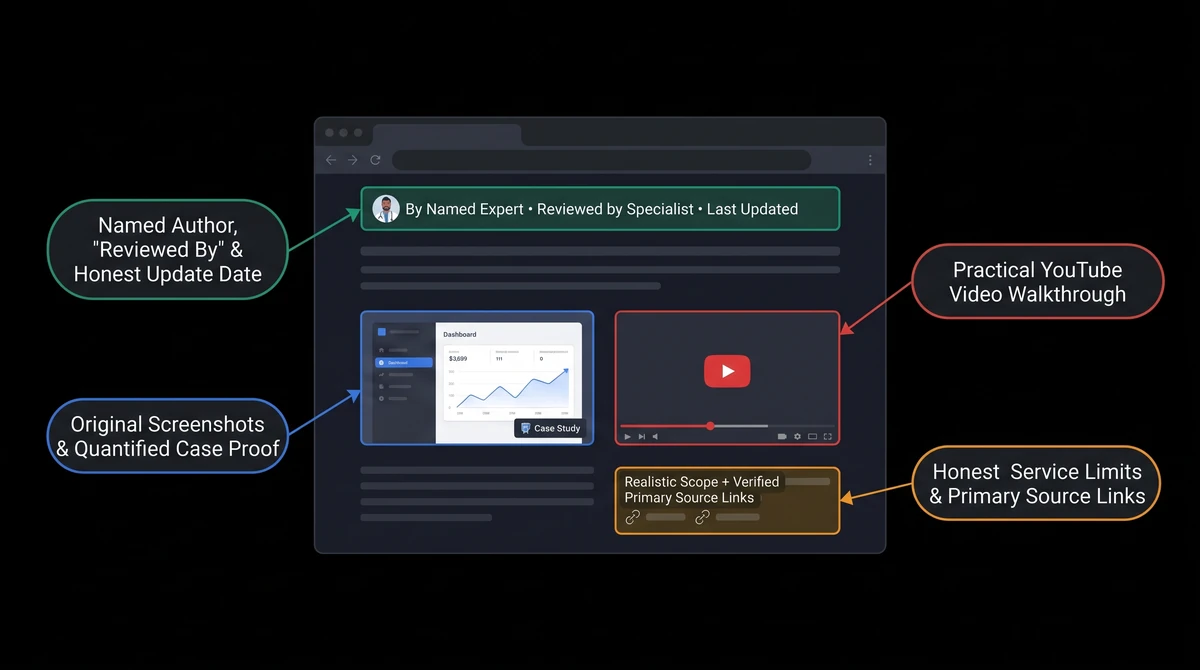
Show real experience by sharing actual project numbers, original screenshots, and practical video walkthroughs that an AI writing tool could never invent.
Google’s people-first content standards evaluate main content for visible human effort, originality, skill, and accuracy, asking whether a page clearly shows first-hand expertise from actually using a product or service. Any language model can write a generic summary in ten seconds. It cannot show a screenshot from your own dashboard or explain how you fixed a real client problem.
All 33 recommended businesses in our study published client case studies or portfolios with measurable outcomes. A typical recommended site listed about 24 case examples, compared with about 2 on a typical skipped competitor, and 16 of the 33 competitors had zero quantified case proof.
Video is even more powerful, especially if you sell a software tool or consumer product. Modern AI systems understand video transcripts, context, and audience engagement on YouTube, and Google’s generative AI search best practices encourage supporting written pages with relevant images and video. When you publish honest YouTube tutorials showing how to use your product, what it does well, and where its limits are, both buyers and AI systems get a strong trust signal. In our study, 22 of the 33 recommended businesses maintained an active YouTube channel or published customer video proof, compared with only 5 of the 33 skipped competitors.
Why Should You State Realistic Claims Instead of Empty Marketing Hype
Buyers and search systems trust businesses that give an honest verdict on what their product or service can actually do instead of promising overnight miracles.
Weak websites fill their pages with empty claims, promising that buying their tool or hiring their team will automatically grow your business. Real practitioners never talk like that. They explain that a tool makes a specific workflow easier if you put in the work, and they state openly who their service is not built for.
When you write service pages, product guides, or comparisons, state realistic outcomes, minimum budgets, and honest trade-offs. Setting clear expectations upfront prevents buyer regret, protects your review ratings, and shows human reviewers and AI systems that your claims are grounded in reality.
Why Should You Link to Primary Sources and Show Expert Review
Linking every statistic, rule, or technical claim to the original source that produced it shows that your team verifies facts instead of repeating rumors.
Citing a blog that copied another blog often spreads outdated or made-up numbers. When you reference research on how generative engines select sources, link directly to primary studies like the Princeton GEO research, which tested how adding citations, quotes, and statistics improved visibility on a research benchmark, alongside practical generative engine optimization workflows.
For medical, financial, legal, or complex technical topics, add a visible Reviewed by line with the name and credentials of the specialist who checked the page. Publishing an editorial policy that explains how your team researches and updates content is also a good practice, even though none of the 66 small and mid-sized businesses in our study had a standalone editorial policy page.
How Can You Build Creator and Expertise Signals on Your Website
Because a business cannot speak for itself, search systems and buyers look for the real human experts behind the brand through named profiles, verifiable credentials, and connected schema markup.
How Do You Highlight the Real People and Credentials Behind Your Business
Replace anonymous labels like Admin, Staff Writer, or Marketing Team with real names, and link every page to a detailed founder or author profile.
A company logo cannot build expertise on its own. People trust the human behind the business first. Google’s quality rater overview tells reviewers to check the background and qualifications of the content creator alongside the website itself.
In our study, all 33 recommended businesses featured named leaders with detailed biographies and a clearly stated specialty. Among the 33 skipped competitors, 19 either hid their leadership or gave no bio, and 21 left their specialty vague.
Link every guide and key page to a dedicated author or founder profile page that states the person’s full name, role, years of hands-on work, core specialty, real project results, state or professional license numbers where they apply, and links to active social profiles.
In March 2026, we worked with a SaaS founder who had a strong reputation as a software architect on GitHub, yet his website never mentioned his name. AI tools treated the business like a faceless vendor and rarely recommended it. After we added a founder page explaining his methodology and linking to his GitHub and LinkedIn profiles alongside other trust updates, his early AI search visibility improved.
Why Should You Connect Your Personal and Brand Identity With Schema Markup
Proper schema markup acts as a machine-readable ID card that helps search and AI crawlers understand your page entities and connect your website to your verified external profiles.
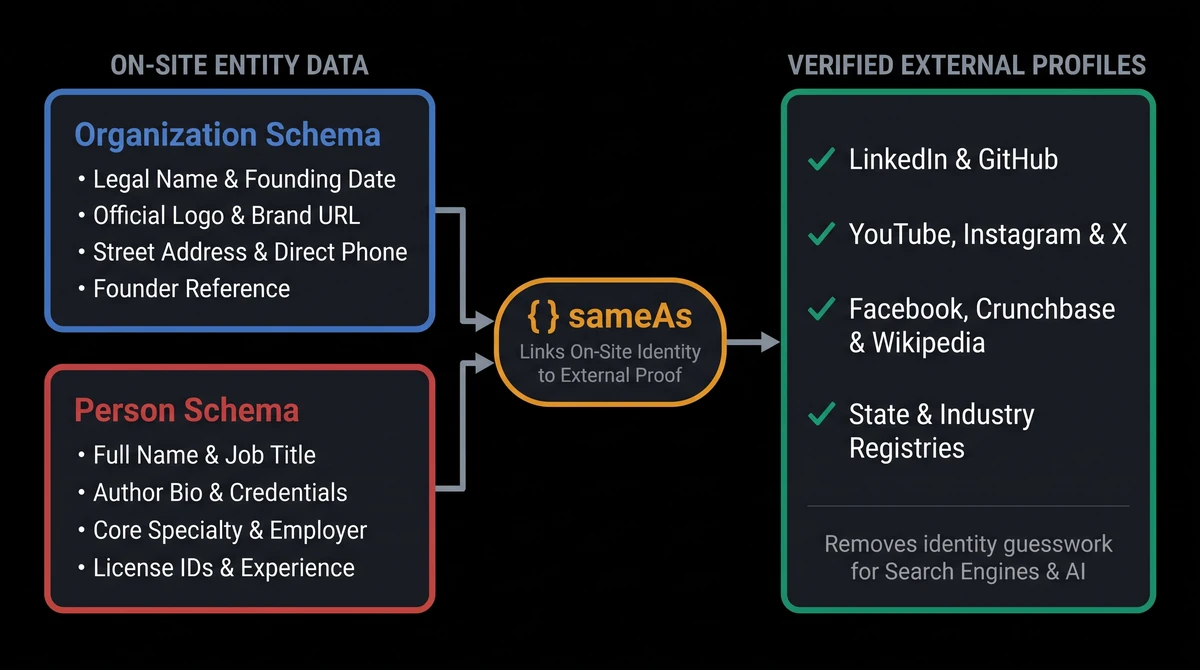
As search shifts from classic blue links to AI Overviews and conversational answers, crawlers need clear, structured entity data so they do not have to guess who runs your business. Deploying connected Organization, LocalBusiness, Person, and ProfilePage schema tells machines explicitly that the founder named on your About page is the exact same specialist on LinkedIn, GitHub, or a state licensing registry.
In our study, 29 of the 33 recommended businesses connected their business and leadership entities to official external profiles using linked schema, compared with 15 of the 33 skipped competitors. In our local transport recovery case study, pairing relational schema markup with clear E-E-A-T entity signals helped a 0.2 DR domain recover from a 48-day traffic crash and earn 47 AI citations without buying backlinks.
- Use Organization schema markup or LocalBusiness schema on your homepage and About page. Include your legal name, founding date, street address, phone number, logo, and founder reference to disambiguate your business and support your Knowledge Panel.
- Use ProfilePage structured data with a Person entity on author and founder pages. List job title, specialty areas, credentials, and employer, matching the visible text on the page.
- Connect both with the
sameAsproperty. Link directly to your official profiles on LinkedIn, GitHub, X, Crunchbase, Wikidata, YouTube, and state or industry registries.
How Can You Build Website Trustworthiness Signals That Convert Buyers
Because Trustworthiness sits at the center of E-E-A-T, clear pricing, plain-English refund terms, verifiable contact details, and authentic customer reviews are the signals that protect your reputation most.
How Should You Present Prices, Service Limits, and Refund Terms
Publish starting prices, package tiers, or clear fee models alongside plain-English refund and cancellation rules so buyers and AI tools never have to guess.
When buyers ask ChatGPT, Perplexity, or Gemini whether your offer is worth the money, clear pricing and refund pages give those systems verifiable facts to cite. Pricing and refund clarity was one of the strongest separators among all 44 signals in our study. All 33 recommended businesses published pricing tiers, rate ranges, or a clear fee model, and all 33 stated refund, warranty, or cancellation terms. Among the 33 skipped competitors, 25 hid pricing behind quote forms and 24 gave no clear refund or cancellation rules. In 25 pairs only the recommended business showed pricing, and in no pair was it the other way around.
Even if your agency or contracting firm quotes custom work, you do not need to leave your pricing page blank. Publish starting package budgets, hourly ranges, or the factors that shape an estimate, and link a clear cancellation or warranty policy in your footer.
What Company, Contact, and Technical Trust Details Should Every Site Show
Display your legal company name, verifiable street address, direct phone and email, applicable license numbers, and clean policy pages on a fast, mobile-friendly site.
A trustworthy business never makes visitors or crawlers hunt for who owns the company or how to reach a real person. In our study, 29 of the 33 recommended businesses published a verifiable street address, while 15 of the 33 skipped competitors used virtual offices or vague service-area labels. Basic technical hygiene, such as having a contact page, privacy policy, and HTTPS, was present on nearly every site in both groups, making those basics the minimum entry ticket rather than a way to stand out on their own.
- A detailed About page. State your legal company name, registration details, founding story, physical headquarters, and leadership team.
- A verifiable Contact page. Give a working email, a direct phone line with office hours, and a physical street address rather than a web form alone.
- Plain-language policy and disclosure pages. Publish accessible Privacy, Terms of Service, Refund, and any affiliate or sponsorship disclosures.
- Honest update dates and a clean page experience. Show
Last updatedonly when a person genuinely refreshes the content, and keep the site fast and clutter-free on mobile.
Why Are Authentic Customer Reviews Your Strongest Everyday Trust Signal
Genuine, detailed customer reviews on independent platforms prove that your real-world delivery matches the promises on your website.
Five-star quotes on your own homepage prove very little on their own, which is why human raters and AI systems look outside your site to confirm customer satisfaction. In our measurements, both groups had similar overall review counts, with 27 of the 33 recommended businesses and 28 of the 33 skipped competitors holding third-party reviews. Yet when we asked AI tools why they preferred the recommended business in head-to-head prompts, review volume and positive sentiment was tied as the most frequently cited reason across all 33 pairs.
We read those two findings together. Having independent reviews is a baseline you cannot afford to miss, and a gap between glowing quotes on your site and unresolved complaints on external platforms will quickly cost you recommendations. Focus on platforms that fit your market, such as Google Business Profile, Yelp, and the Better Business Bureau for local services, or Clutch, G2, and Trustpilot for agencies and software. Ask happy clients for honest feedback, reply to complaints in public, and never buy or gate reviews.
How Can You Build Off-Site Authoritativeness Through Your Personal and Brand Network
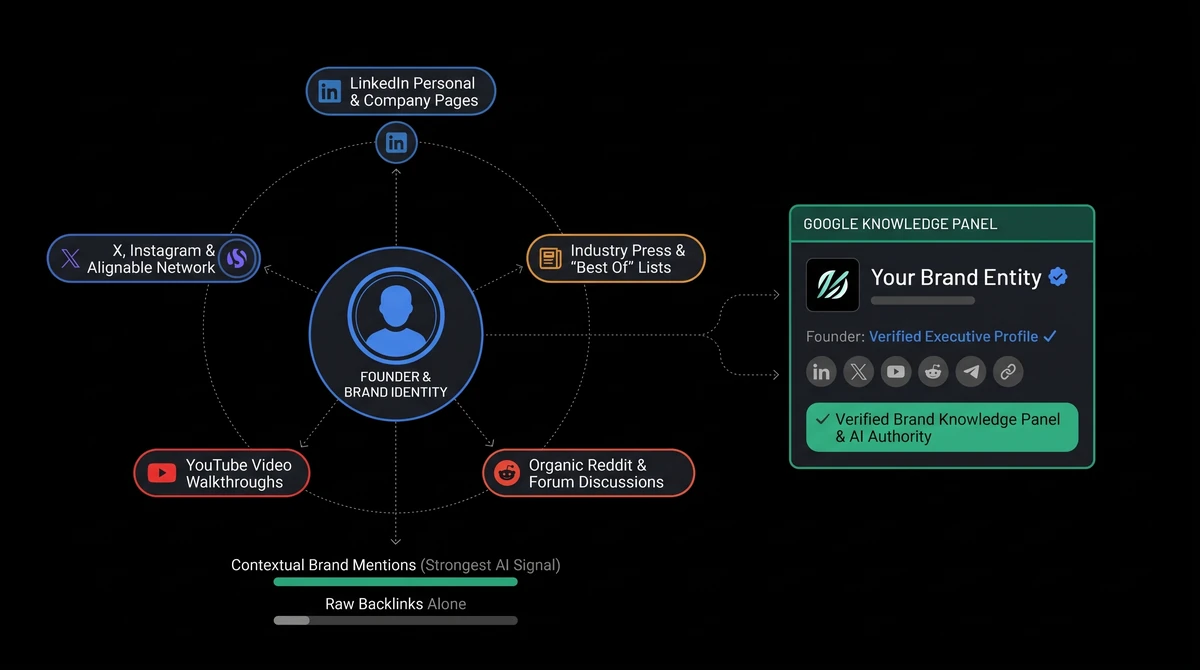
Instead of just dropping your business link into random directories, build the personal identity and network of the founder alongside your brand across LinkedIn, social platforms, niche communities, and industry press.
Why Should You Build the Founder’s Personal Identity Before Distributing the Brand
A business becomes known and trusted through the person behind it, so building the founder’s personal presence across professional and niche networks is one of the fastest ways to grow off-site authority.
Most generic SEO advice tells you to list your company on dozens of directories. In our 33-pair study, basic directory listings did not separate winners from losers at all, because almost every business already had them. What separated the winners was visible human leadership and real network presence across the wider ecosystem, which is the core idea behind search everywhere optimization.
In 26 of the 33 recommended businesses, the founder or lead executive maintained an active personal LinkedIn profile, and 29 of 33 maintained an active LinkedIn company page, compared with just 10 and 15 among the skipped competitors. Before trying to push a company logo everywhere, strengthen your personal identity as the business owner or practitioner.
- Grow your LinkedIn personal and company activity. Share real lessons from client work, industry observations, and honest product updates from your personal profile while keeping your company page active.
- Network on X, Instagram, and B2B communities like Alignable. Connect with peers, local business owners, and niche partners on platforms like X, Instagram, and Alignable so people in your industry know who you are and what your business solves.
- Participate honestly on Reddit and niche forums. In our study, 24 of the 33 recommended businesses were discussed in unprompted Reddit or forum threads, compared with 12 of 33 competitors. Answer real questions in your niche and let genuine customer experiences spark community mentions.
- Keep your entity facts identical everywhere. In our study, 31 of the 33 recommended businesses had a Google Knowledge Panel on branded searches, compared with 8 of 33 competitors. Keeping your name, company details, bio, schema, and social links consistent across the web helps Google connect your personal and business entities.
Why Do Contextual Brand Mentions Beat Generic Backlinks
Across both our study and wider industry research, descriptive mentions of what your business does best in trusted publications and comparison lists align with AI visibility much more closely than raw backlink counts.
In our 33-pair study, raw referring domain counts did not meaningfully separate the recommended businesses from the skipped competitors. An Ahrefs study of 75,000 brands points the same way, finding a 0.664 Spearman correlation between branded web mentions and Google AI Overview visibility compared with 0.218 for backlinks and 0.295 for referring domains. Correlation does not prove causation, but the practical direction is clear.
All 33 recommended businesses in our study had independent press or trade media mentions, with a typical winner earning about 24 press mentions compared with about 2 for a typical skipped competitor. Nearly half of the winners (16 of 33) appeared in industry awards or independent “best of” comparison lists, compared with 5 of 33 competitors. Sharing original data and real benchmarks through journalist platforms like Qwoted, Featured, and Connectively is a reliable way to earn those descriptive mentions.
Practical Two-Stage E-E-A-T Checklist Across All Four Pillars
Use this two-stage checklist to strengthen your website and brand across Experience, Expertise, Authoritativeness, and Trustworthiness, completing Stage 1 first before expanding into Stage 2.
No checklist guarantees instant rankings or automatic AI citations, because a local contractor, a SaaS product, and a clinic face different buyer expectations. Complete the Stage 1 foundation across all four pillars in your first 30 to 45 days, then build the Stage 2 signals over the following 45 to 90 days.
| E-E-A-T Pillar | Stage 1 Foundational On-Site Setup | Stage 2 Ongoing Proof and Off-Site Expansion | What Search and AI Systems Check |
|---|---|---|---|
| Trustworthiness | Publish clear starting prices or fee models, plain-English refund and cancellation terms, verifiable street address, direct phone and email, legal policies, and HTTPS. | Collect steady, authentic customer reviews on 2 to 3 independent platforms and reply publicly to all feedback. | The business is real, reachable, honest about costs, and trusted by paying customers. |
| Experience | Add real client case studies with measurable outcomes, original screenshots or photos, and realistic claims with honest service boundaries. | Publish YouTube tutorials showing how to use your product along with its pros and cons, and encourage genuine user discussions on Reddit and forums. | The team has actually done the work, tested the product, and solved real customer problems. |
| Expertise | Replace Admin bylines with named practitioners, build founder and author pages with verifiable credentials or license IDs, and state a clear specialty. | Deploy connected Organization, LocalBusiness, Person, and ProfilePage schema with sameAs links, add Reviewed by lines on technical topics, and link to primary sources. | Every page connects to a real specialist whose credentials match external registries and profiles. |
| Authoritativeness | Build deep, interlinked topic clusters that answer core and follow-up buyer questions thoroughly without thin filler pages. | Grow the founder’s personal network on LinkedIn, X, Instagram, and Alignable, earn descriptive press and comparison mentions, and keep entity facts consistent. | Respected publications, peers, and search systems recognize the founder and brand in their niche. |
What Common Mistakes Weaken Your E-E-A-T Signals
The fastest ways to hurt your E-E-A-T are inventing fake authors, making exaggerated marketing claims, bumping dates without real edits, buying reviews, and adding schema that contradicts your page.
Each of these shortcuts tries to fake trust instead of showing real human proof.
- Fake authors and AI-generated headshots. Google’s people-first content guidelines explicitly warn that fabricating creator profiles with AI-generated headshots, made-up names, or false credentials is deceptive and marks a page as untrustworthy.
- Overpromising and empty hype. Claiming your product or service guarantees automatic success makes both careful buyers and AI evaluation models skeptical.
- Script-bumped update dates. Changing
Last updateddates to make pages look fresh when the content has not substantially changed is flagged directly in Google’s self-assessment guidelines. - Bought or gated reviews. Paying for fake reviews or hiding unhappy customers breaks platform rules and creates a clear trust gap when buyers check Reddit or the Better Business Bureau.
- Schema without visible proof. Following Google’s structured data quality rules, never mark up credentials or ratings in JSON-LD that visitors cannot see on the page.
- Blocking legitimate search and AI crawlers. Check that
robots.txt,noindextags, and firewall captcha rules do not stop search and AI crawlers from reading your key pages and trust pages.
What Should You Check First If Your Visibility Dropped
Before you rewrite any blog posts after a traffic or AI visibility drop, check whether the drop lines up with a Google update, a site change, or a technical error, and then fix your trust gaps in order.
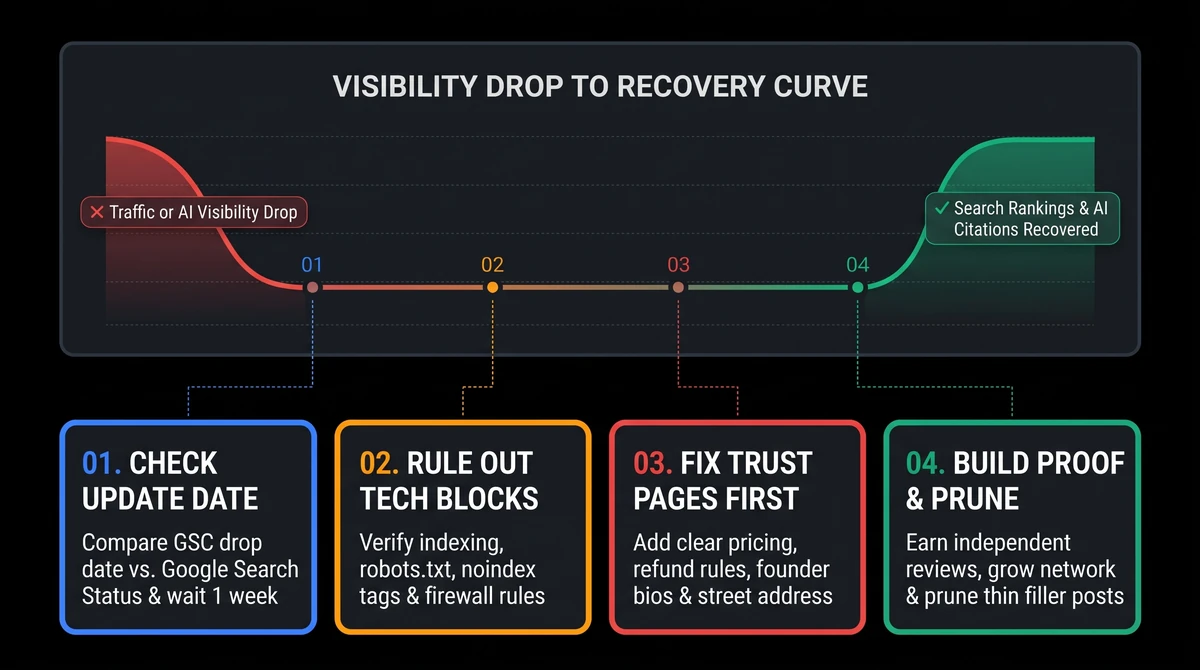
- Confirm the date in Search Console. Compare the day your visibility changed against the Google Search Status Dashboard, and follow Google’s core updates guide by waiting at least one full week after an update finishes before comparing numbers.
- Rule out technical blocks. Verify that your key pages are indexed and not blocked by
robots.txt, accidentalnoindextags, or firewall rules after a site change. - See which pages lost ground. A drop on service and pricing pages usually points to pricing, refund, or review gaps, while a drop across blog posts often points to thin or repetitive content.
- Fix trust gaps in order and prune thin posts. Start with pricing and policy pages, move next to founder bios and contact details, then build reviews and founder network mentions, while merging or removing thin posts written only to chase keywords.
How Can You Measure Whether Your E-E-A-T Improvements Are Working
Because no SEO tool offers an official E-E-A-T score, track page-level Search Console trends, branded and founder search growth, monthly AI prompt tests, and lead quality.
Google notes that some on-site improvements are reflected within days or weeks, while broader site-wide quality evaluations can take several months or show up during subsequent core updates. Keep a simple dated log of every trust, author, and content change, and check four indicators once a month alongside your broader answer engine optimization tracking.
- Search Console page performance. Watch impressions, clicks, and average position on the specific service, pricing, and guide pages you upgraded.
- Branded and founder search demand. Track how many people search directly for your company name and your founder’s name in Google Search Console.
- Multi-turn AI prompt checks. Ask the same buyer questions, plus follow-ups about pricing and reviews, each month across Google AI Overviews, ChatGPT, Perplexity, and Gemini to see whether your brand is shortlisted and described accurately.
- Sales conversation quality. Notice whether new prospects mention your case studies, YouTube videos, LinkedIn posts, or transparent pricing on the first call.
If you want an experienced team to audit your site and build these signals step by step, our team can help through AI search optimization, content strategy and marketing, search everywhere optimization, and SEO services.
How We Ran Our 66-Business Study
This internal study compared 66 small and mid-sized businesses across 33 industry pairs in November 2026 to see which trust signals appear most often on recommended brands.
- How pairs were selected. Each pair matched two similar businesses in the same market, excluding massive tech giants like Microsoft. One business performed strongly across both traditional search rankings and AI search engines, while a comparable competitor in the same niche was consistently skipped. We keep the 66 businesses anonymous.
- AI prompt verification. We ran 198 live prompts across ChatGPT (99 runs across 3 runs per pair), Google AI Overviews (33 runs), Perplexity (33 runs), and Google Gemini (33 runs). The recommended business appeared in 196 of the 198 runs and the skipped competitor appeared in 2.
- Signals measured. We checked 44 on-site and off-site signals per business, including pricing, refund terms, case studies, leadership bios, schema, reviews, YouTube videos, LinkedIn activity, and Knowledge Panels, alongside live Semrush Authority Score and traffic data pulled on the same day.
- Scope and limits. Because we grouped businesses by their existing visibility, these results show real-world correlations rather than proving that any single signal caused a recommendation on its own. Most of the businesses in the sample serve the San Francisco Bay Area, Silicon Valley, and US B2B markets, so exact ratios may vary in other regions.
66-Business Study Benchmark: Common E-E-A-T Practices Among Recommended Brands
(This benchmark shows which E-E-A-T and transparency practices were most common across the 33 recommended businesses compared with the 33 skipped competitors in our study. While these practices do not guarantee rankings on their own, businesses that perform strongly in Google and AI search consistently maintain them—making these signals a practical priority for improving your brand’s visibility and buyer trust.)
Frequently Asked Questions About Building E-E-A-T Signals
How long does it take to build strong E-E-A-T signals?
It depends on the signal. On-site changes such as publishing clear pricing and refund terms, adding named founder pages, and deploying connected schema markup can be crawled within days or weeks. Off-site signals such as authentic customer reviews, YouTube tutorials, founder networking, and a Google Knowledge Panel usually build over three to six months.
Is E-E-A-T a direct Google ranking factor?
Not as a single numerical score. Google uses E-E-A-T as a human quality evaluation framework that helps guide and validate its automated ranking systems. There is no single E-E-A-T score to raise, so you improve it by strengthening the real signals of trust, experience, expertise, and authority around your business.
Will improving E-E-A-T guarantee that my rankings or traffic recover?
No. E-E-A-T is not a switch you turn on, and no one can guarantee rankings or automatic AI citations. Fixing trust, identity, and content-proof gaps removes credibility problems that may be holding your site back, and Google notes that site-wide quality improvements can take several months or the next core update to show their full effect.
Can a website with a lower Semrush Authority Score still beat bigger competitors in AI search?
Yes, it can happen. In 12 of the 33 pairs in our study, the business recommended by AI tools had an equal or lower Semrush Authority Score than the competitor that got skipped. Authority still helped in most pairs, so backlinks remain useful, but our local transport recovery case study shows how a brand-new 0.2 DR domain earned 47 AI citations ahead of national directories by pairing clear business facts with connected entity schema.
How do you show first-hand experience if your business is new?
A new company does not need ten years of history to show real experience. Document your own live tests, publish an original audit of your niche, record honest YouTube walkthroughs showing how your product works and where its limits are, and highlight the founder’s earlier career work on a dedicated profile page.
Does adding Author and Organization schema directly improve E-E-A-T?
Schema markup does not invent credibility if the visible page lacks substance, but it plays a vital role in helping crawlers understand your page entities and connect your Organization, LocalBusiness, and Person data to official profiles through sameAs links. Linked entity schema was present on 29 of the 33 recommended businesses in our study, compared with 15 of the 33 skipped competitors.
Can you use AI tools in content writing without hurting your E-E-A-T signals?
Yes. As explained in Google’s AI content guidance, Google evaluates the quality, accuracy, and usefulness of the finished page rather than the tool that helped draft it. Use AI to organize research, then have a real practitioner add first-hand examples, state realistic claims, check every fact against primary sources, and take personal accountability on the byline.
Which pages on a website should you optimize for E-E-A-T first?
Start with your commercial service and product pages, your pricing and refund policy pages, your About and Contact pages, and your founder or practitioner profiles before rewriting older blog posts. When buyers use Google or AI assistants to compare vendors, those commercial and trust pages are the first places checked.